
CFI is on a mission to enable anyone to be a great financial analyst and have a great career path. In order to help you advance your career, CFI has compiled many resources to assist you along the retained earnings path. A merger occurs when the company combines its operations with another related company with the goal of increasing its product offerings, infrastructure, and customer base.
Adjustments to Retained Earnings
Conversely, if a current liability, like accounts payable, increases this is considered a cash inflow. This is because the company has yet to pay cash for something it purchased on credit. By understanding and effectively managing retained earnings, companies can ensure they are equipped for sustainable development and value generation for shareholders.
Financial statements

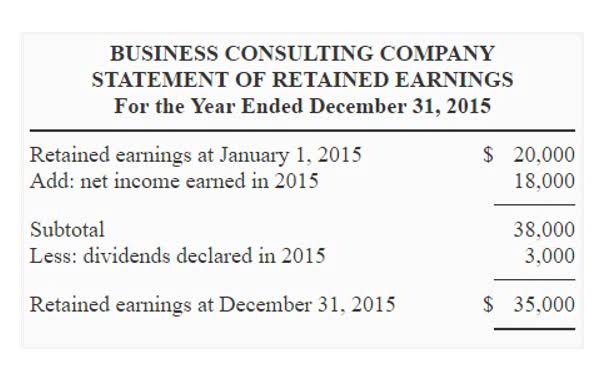
Keep track of retained earnings, net income, and equity with a complete monthly financial reporting template. Begin the statement by stating the opening balance and retained earnings amount carried over from the previous fiscal year’s end. Opening with the correct balance is vital as it sets the groundwork for the subsequent calculations. This financial flexibility adds resilience to the business, helping it navigate harsh market conditions.
Try QuickBooks Accounting Software for Small Businesses Free for 30 Days
The firm need not change the title of the general ledger account even though it contains a debit balance. The most common credits and debits made to Retained Earnings are for income (or losses) and dividends. Occasionally, accountants make other entries to the Retained Earnings account. The retained earnings portion of stockholders’ equity typically results from accumulated earnings, reduced by net losses and dividends. Like paid-in capital, retained earnings is a source of assets received by a corporation.
Related AccountingTools Courses
Typically, it is up to the company’s management to decide whether to keep the profits or distribute them to the shareholders. Even if the last debt repayment option also causes money to leave the company, it does affect the books (for instance, by preventing interest payments in the future, which makes it eligible for retained earnings). Retained earnings appear under the shareholder’s equity section on the liability side of the balance sheet, and often companies will show this as a separate line item. There are some limitations with retained earnings, as these figures alone don’t provide enough material information about the company. For example, if a company declares a stock dividend of 10%, meaning the company would have to issue 0.10 shares for each share held by the existing stockholders. If you as a shareholder of the company owned 200 shares, you would then own an 20 additional shares, or a total of 220 (200 + (0.10 x 200)) shares once the company declares the stock dividend.
- In financial modeling, it’s necessary to have a separate schedule for modeling retained earnings.
- This article explores the definition, importance, and components of the statement of retained earnings, as well as its role in business financial reporting.
- So, keep those numbers tight and right to continue the narrative of your company’s financial health and strategy.
- All you need is your net income, your previous retained earnings, and the formula.
- It provides insights into how much profit is retained in the business after dividends are distributed to shareholders.
- Understanding the difference between appropriated and unappropriated retained earnings is crucial for anyone analyzing a company’s financial statements.
- Retained earnings hold enormous significance for business owners and potential investors as they are a barometer of a company’s financial health and historical profitability.
Capex should be recorded in operating activities because it relates to running the business, so investing retained earnings statement cash flow is overstated. Now connect the remaining cash movements to long-term assets and to debt/equity. If your model is built correctly, this check should equal zero for all periods.

While retained earnings are reported on the balance sheet under shareholders’ equity, the profit and loss statement is a standalone financial document. Retained earnings play a crucial role in a company’s financial health and have a significant impact on the shareholders’ equity. In a financial statement, retained earnings are reported under the shareholder equity section of the balance sheet. This account serves as a http://noetn.online/learn-about-us-and-our-team-of-denver-bookkeepers/ measure of the company’s ability to generate profit, reinvest, and create value for shareholders. A statement of retained earnings is a financial document that shows changes in a company’s retained earnings over a specific period.

